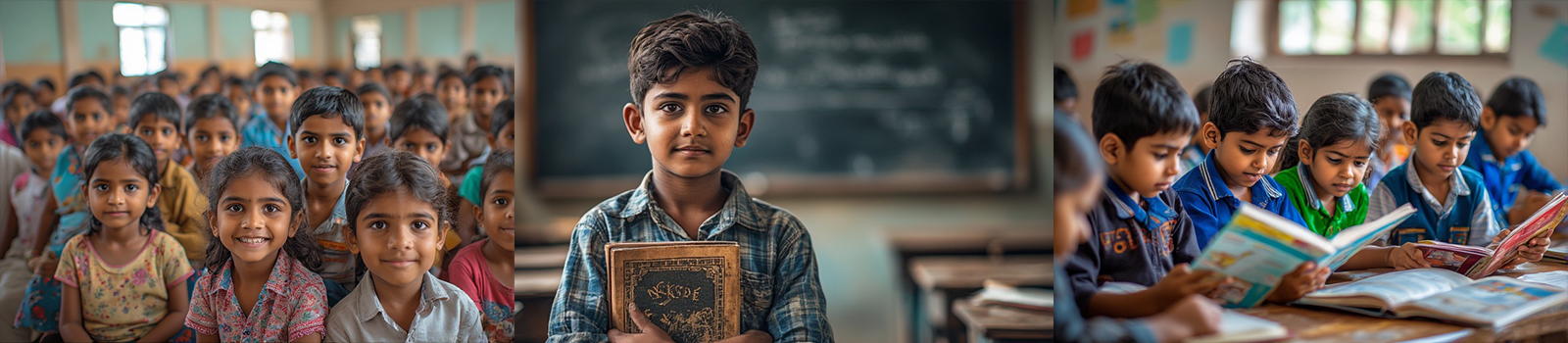
The program promotes quality education based on regional board syllabi and also facilitates learning through the National Institute of Open Schooling (NIOS) for both children and adults. To reduce financial barriers, it covers expenses for school fees, uniforms, and study materials. The scheme includes inclusive services such as daycare, mid-day meals, and recreational activities to foster overall development and well-being. Through its holistic approach, Shiksha Jyoti aims to create a nurturing, inclusive educational environment for the most vulnerable sections of society.
From economically disadvantaged families needing foundational education support.
Especially those left out of Sarva Shiksha Abhiyan and needing NIOS-based support.
Those who require inclusive education environments and special care support.
Seeking second-chance education through flexible NIOS-based learning paths.
Needing daycare, mid-day meals, and structured learning during work hours.
To provide foundational education to children (ages 4–9), support school dropouts and children with special needs through NIOS, while offering daycare services, school fees, uniforms, and mid-day meals.
Survey and collaborate with local authorities to identify high-need areas and partner with local schools for infrastructure alignment.
Target children aged 4–9, dropouts (6–14), and children with special needs from low-income and marginalized communities.
Provide books, uniforms, stationery, and cover school fees through collaboration with local schools and authorities.
Enroll school dropouts in NIOS and offer structured mentoring and teaching support for formal education completion.
Set up daycare and provide nutritious meals for children of daily wage workers to support learning and safety.
Monitor academic and social progress via committees and quarterly evaluations to improve outcomes.
| Sl. No. | Component | Description | % of Total Budget |
|---|---|---|---|
| Non-Recurring Expenses | |||
| 1 | Uniforms | 2 sets per child (including shoes) | 12% |
| 2 | Books & Stationery | Textbooks, notebooks, pencils, etc. | 8% |
| 3 | Daycare Facilities Setup | Initial infrastructure, safety, furnishing | 10% |
| Recurring Expenses | |||
| 4 | School Fees Support | Annual tuition reimbursement | 20% |
| 5 | NIOS Enrollment & Support | Flexible schooling for dropouts/special needs | 3% |
| 6 | Mid-Day Meals | Nutritious meals (₹20 × 240 days) | 40% |
| 7 | Monitoring & Evaluation | Progress tracking, reporting, audits | 5% |
| 8 | Miscellaneous | Hygiene kits, contingency, admin costs | 2% |
| Total Budget Allocation | 100% | ||
This estimate ensures holistic support — including academic costs, nutrition, and safe daycare — while remaining scalable and grant-friendly for replication across multiple communities.
Increased number of children enrolling in formal education, including school dropouts.
Children receiving support will show improved learning outcomes.
Adult and youth learners will complete their schooling through NIOS and improve their literacy.
Daycare facilities with nutritional meals and recreational activities will improve children's well-being, especially those from daily wage families.
The scheme will help empower children from marginalized communities through education and social inclusion.